

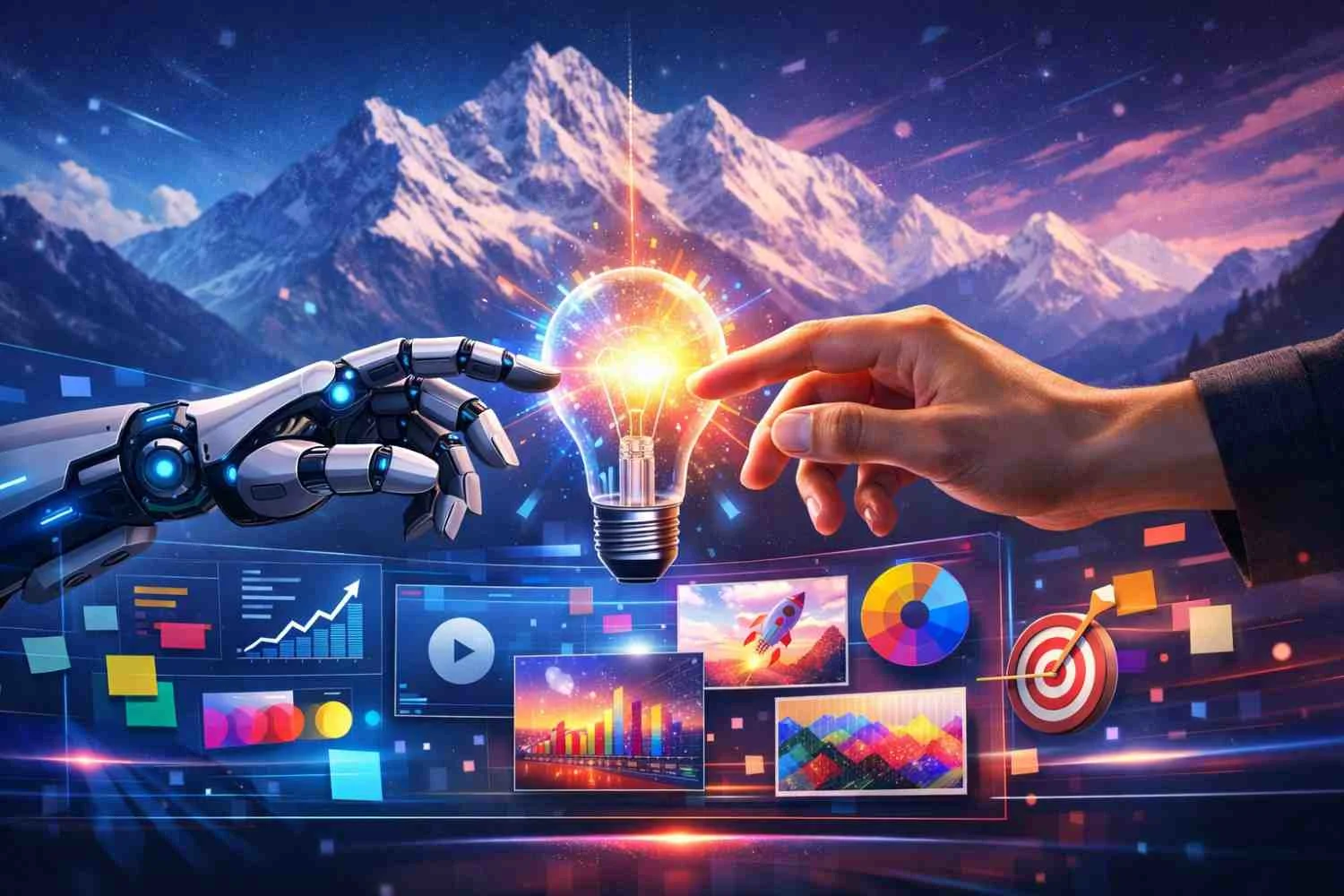
How to Combine AI and Human Creativity for Better Marketing Campaigns
AI is reshaping marketing with powerful data, automation, and personalization. At the same time, human creativity remains the heartbeat of emotion, story, and brand identity. When you intentionally blend AI and human creativity in marketing, you get AI marketing campaigns that are smarter, more authentic, and designed for performance at scale.
Why AI Alone Is Not Enough in Marketing
AI is impressive, but it’s not magic. If you depend only on AI, your AI marketing campaigns can end up feeling cold, repetitive, or generic. Let’s break down why.
1. Data without emotion
AI tools are excellent at analysing huge datasets: user behaviour, click-through rates, search intent, time on page, and more. They can tell you what is happening and often predict what might happen next.
But AI doesn’t feel.
It doesn’t know the rush of excitement when someone discovers a new brand, the comfort of a familiar logo, or the pride of a customer sharing a product they love. Without human input, AI and human creativity in marketing quickly become lopsided—full of numbers but empty of emotional depth.
2. Automation without originality
AI can automate:
● Ad placements
● Email sends
● Social media scheduling
● A/B testing
That’s powerful, but automation alone can never define why your brand matters or what makes it different.
If you rely too heavily on automation, you risk:
● Repeating the same safe ideas
● Following trends instead of setting them
● Losing the spark that makes your campaigns memorable
Originality requires human curiosity, lived experiences, and intuition. AI can support that, but it cannot originate it by itself.
3. Risk of generic messaging
We’ve all seen it: content that sounds “AI-written”—technically correct, but flat. When AI is used without strong human direction, your AI marketing campaigns can:
● Sound similar to your competitors
● Miss subtle cultural nuances
● Fail to capture your unique brand voice
In a world full of noise, generic content is invisible. This is where human creativity brings back flavour, personality, and boldness.
Role of Human Creativity in Marketing Campaigns
Human creativity is the soul of any effective campaign. It’s what transforms raw insights into powerful narratives.
Storytelling & brand voice
Great brands are built on great stories:
● Who you are
● Why you exist
● What you stand for
Humans craft the stories that AI then helps distribute and optimize. Your brand voice—playful, bold, philosophical, minimalist—comes from human choices, not algorithms.
A human creative team can:
● Decide whether a campaign should feel humorous or serious
● Choose references, metaphors, and cultural hooks
● Build campaign arcs that evolve over weeks or months
This storytelling layer is where AI and human creativity in marketing intersect: AI informs, humans narrate.
Emotional connection
People don’t form relationships with data—they form relationships with feelings.
Human creatives bring:
● Empathy: understanding what your audience fears, hopes, and dreams
● Sensitivity: knowing when a topic is too heavy, too light, or perfectly timed
● Instinct: sensing when an idea is strong even before any data exists
These emotional decisions drive the heart of AI marketing campaigns: the visuals, the tone, the core message.
Cultural relevance and originality
Markets differ by culture, geography, and context. A phrase that works in one city might miss the mark in another.
Humans:
● Understand local festivals, humour, and social norms
● Spot what’s trending in real time—beyond what data reflects
● Bring their unique background and worldview into the creative process
This is especially true in places like Dharamshala, where tradition, spirituality, and modern technology coexist. The creativity born here has its own colour and rhythm—something AI alone could never invent.
How AI Enhances Creative Marketing
Now let’s look at the flip side: where AI really shines and makes human creativity more powerful.
Audience insights & data analysis
AI digs through data at a scale humans simply can’t match. It can:
● Segment audiences by behaviour, interest, and intent
● Identify which content formats work best
● Track customer journeys across platforms
This helps creative teams understand who they’re talking to, what they care about, and how they interact with content. AI and human creativity in marketing become far more impactful when creatives aren’t guessing—they’re designing with clear insight.
Content ideation & optimization
AI tools can:
● Suggest blog topics based on keyword gaps
● Generate first-draft headlines or social posts
● Recommend optimal posting times
These ideas aren’t the final output—but they give creatives a fast starting point. Instead of staring at a blank screen, your team can refine, reframe, and elevate AI suggestions into strong campaign concepts.
Personalization at scale
Personalization is where AI marketing campaigns really stand out.
AI can:
● Dynamically adjust website content based on user behaviour
● Send personalized product recommendations
● Customize email subject lines and body copy to each segment
Human creatives define the core message and brand voice. AI helps deliver that message in a hundred different variations to the right people at the right moment.
Predictive performance insights
AI can analyse what has worked in past campaigns and predict:
● Which creatives are likely to perform best
● Which audience segments are most profitable
● How budget should be allocated across channels
This doesn’t replace human judgment—but it gives marketers a data-backed compass. Creatives can experiment, while AI measures and guides.
Best Ways to Combine AI and Human Creativity
So, how do you practically combine AI and human creativity in marketing? Think of it as a partnership, not a replacement.
1. AI for research, humans for ideas
Start your campaign planning like this:
● Use AI to:
○ Analyse competitors
○ Explore keyword trends
○ Understand audience questions and pain points
● Then let humans:
○ Brainstorm campaign themes
○ Build storylines and hook ideas
○ Map the emotional journey of the audience
AI prepares the soil; human creativity plants the seed.
2. AI-assisted content creation & editing
AI is powerful in the drafting and refining stages of AI marketing campaigns:
● Generate rough drafts for emails, posts, or ads
● Use AI suggestions to improve clarity, structure, or length
● Let humans inject humour, nuance, and brand personality
This approach speeds up content creation while keeping it uniquely “you.”
3. Human-led brand strategy with AI execution
Your overall brand strategy should always be human-led:
● What your brand stands for
● Who your ideal customers are
● How you want people to feel after interacting with you
Once this is defined, AI tools can help execute:
● Automating ad placements based on performance data
● Personalizing content across audiences
● Managing complex cross-channel campaigns
Humans drive the vision; AI manages the heavy lifting.
4. Continuous testing using AI insights
The best AI marketing campaigns never “set and forget.” Instead, they:
1. Launch creative concepts crafted by humans
2. Use AI tools to measure performance in real time
3. Iterate based on insights:
○ Adjust headlines
○ Change visuals
○ Refine targeting
4. Repeat the cycle
This loop—create, test, learn, refine—is where AI and human creativity in marketing reach their full potential.
Learning This Blend at PulsePlay Academy in Dharamshala
At PulsePlay Academy, nestled in the calm of Dharamshala with the Himalayas watching over, learners explore this exact balance between technology and imagination.
Students don’t just study AI tools in isolation—they learn how to:
● Use AI for research, ideation, and analytics
● Develop strong storytelling and brand-thinking skills
● Design AI marketing campaigns that still feel deeply human
Through our collaboration with PulsePlay Digital, this learning becomes real-world practice. After completing their course, students can step into internship opportunities at PulsePlay Digital, where they:
● Work on live marketing projects for real clients
● Use AI tools for campaign optimization, content drafting, and targeting
● Collaborate with creative strategists and designers
● Experience how AI and human creativity in marketing coexist in a professional environment
This bridge from classroom to live campaigns is what makes the learning journey truly complete. You don’t just hear about the future of marketing—you actually work inside it.
And if you want to explore more about how we look at AI and Human Creativity as part of modern learning and careers, our main site is the best place to start.
Real-World Use Cases
To make all this more concrete, here are some high-level examples of AI marketing campaigns powered by AI and human creativity.
1. AI-powered ad targeting + human storytelling
● AI identifies high-intent audiences based on behaviour and interest
● Human creatives design emotionally resonant ad concepts with strong hooks
● AI then optimizes budget and placements to show the right story to the right people
Result: fewer wasted impressions, more relevant engagement.
2. AI-generated drafts refined by creative teams
● AI generates first drafts of blog posts, email sequences, or product descriptions
● Creative teams rewrite, refine, and adapt the content to match brand voice
● The final output is sharper, quicker to produce, and deeply on-brand
Result: faster production without sacrificing quality.
3. Campaign optimization using AI analytics
● Human team launches a multi-channel brand awareness campaign
● AI tracks performance across platforms, devices, and formats
● Insights show which creatives, audiences, and messages perform best
● The team adjusts messaging, visuals, and spend based on these insights
Result: continuous improvement and better ROI over time.
Benefits of AI + Human Collaboration
When you blend AI and human creativity in marketing the right way, you unlock clear advantages:
● Better campaign performance – Smarter targeting and optimization mean higher engagement and conversion.
● Faster execution – AI speeds up research, drafting, and analytics, letting creatives focus on big ideas.
● Consistent brand messaging – Humans define the voice; AI ensures it’s delivered consistently across channels.
● Higher ROI – Resources are spent where they work best, thanks to AI insights and human strategy.
Common Mistakes to Avoid
While using AI marketing campaigns, marketers often fall into a few traps.
Over-automation
Relying too heavily on automation can make your brand feel robotic. Remember: tools support strategy; they are not the strategy.
Ignoring brand tone
If you copy AI outputs without editing, you risk losing your distinct voice. Always pass AI-generated content through a human “brand filter” to maintain consistency.
Relying solely on AI outputs
AI is a starting point, not the finish line. Use it to accelerate your work, not replace thought, nuance, and creativity.
Future of AI-Driven Creative Marketing
The future of AI and human creativity in marketing is not a battle—it’s a partnership that keeps getting stronger.
We’re moving toward:
● More intelligent tools that understand context and tone better
● Hyper-personalized AI marketing campaigns that still feel human
● Workflows where AI handles complexity, and humans handle meaning
For students and professionals learning in places like PulsePlay Academy and creating with teams like PulsePlay Digital, this future is already here. The skills that will matter most are not “AI vs creativity,” but the ability to combine them with confidence.
Conclusion
The most impactful marketing today doesn’t come from AI alone or human creativity alone—it comes from a deliberate balance of both. When you use AI for data, speed, and scale, and humans for story, empathy, and originality, your AI marketing campaigns become not just efficient, but unforgettable.
FAQs
Human creativity is what gives your campaigns personality and emotional depth. AI can tell you which audience to target and what content performs best, but it can’t truly understand humour, irony, or cultural nuance. Human creatives shape the narrative, tone, and message so your brand feels alive and relatable, not robotic.
AI supports creative marketing by handling research, data analysis, and optimization. It can suggest topics, test multiple ad variations, personalize experiences, and measure performance in real time. This lets creative teams spend less time on manual tasks and more time on strategy, storytelling, and design.
No. AI can assist, amplify, and accelerate—but it cannot replace human creativity. It doesn’t have personal experiences, intuition, or emotional understanding. The most successful brands use AI and human creativity in marketing together: AI provides the insights and structure, while humans bring originality and meaning.
Some effective ways include:
● Using AI for audience research and trend analysis
● Letting AI generate drafts that humans refine
● Designing human-led brand strategies with AI handling execution
● Running continuous tests where AI analyses performance and humans refine the creative
This partnership keeps your campaigns both smart and soulful.
AI improves performance by:
● Identifying the best-performing channels and formats
● Optimizing bids and budgets automatically
● Personalizing content to different segments
● Providing real-time insights for faster decision-making
When combined with a strong creative direction, these capabilities lead to higher engagement, better conversion rates, and stronger ROI.
Common mistakes include:
● Over-automating and losing the human touch
● Publishing AI-generated content without editing for tone and accuracy
● Ignoring cultural or contextual nuances
● Treating AI as a replacement for strategy instead of a tool
Avoid these by keeping humans in control of brand identity and final decisions.
AI-generated content can be useful as a starting point, especially for structure or basic messaging. However, brand storytelling demands depth—unique angles, lived experience, and emotional resonance. AI can help outline and draft, but humans should always refine and shape the final narrative.
To maintain brand voice:
● Define a clear brand style guide (tone, vocabulary, dos and don’ts)
● Use AI outputs as drafts, not final content
● Always review, edit, and contextualize AI-generated text
● Train AI prompts with examples of your brand voice
This keeps AI marketing campaigns aligned with your identity instead of sounding generic.
Marketers often use:
● AI-powered analytics platforms for insights and segmentation
● AI writing assistants for drafting and ideation
● Design tools with AI features for image generation or layout suggestions
● Marketing automation platforms for email, ads, and personalization
At PulsePlay Academy and PulsePlay Digital, students and interns learn how to use these tools not as shortcuts, but as creative partners.
The future lies in deeper collaboration. AI will become more context-aware and integrated into everyday creative workflows, while marketers will focus on higher-level strategy, ethics, originality, and human connection. Those who understand how to combine AI and human creativity in marketing will lead the next generation of AI marketing campaigns—smarter, faster, and more human than ever.