
Digital Marketing vs Traditional Marketing: Career Comparison
In the quiet valleys of Dharamshala, where the mountains create space for reflection and new ideas seem to arrive with the morning mist, the world of marketing can feel surprisingly close. A business today can reach a customer through a search result, social media post, email, television advertisement, billboard, event, or a carefully planned combination of them all.
For students considering a career in marketing, this creates an important question: Should you choose digital marketing or traditional marketing?
The answer is not as simple as choosing one over the other. Both fields offer meaningful career opportunities, but they demand different skills, work styles, and approaches. Digital marketing is particularly attractive to people interested in technology, analytics, content, social platforms, and measurable results. Traditional marketing continues to suit professionals drawn to branding, advertising, public relations, media, and events. Increasingly, however, businesses need marketers who understand both.
What Is Digital Marketing?
Digital marketing uses online channels and technology to attract, engage, convert, and retain customers. Major areas include SEO, paid advertising, social media marketing, content marketing, email marketing, marketing automation, analytics, conversion rate optimization, and influencer marketing.
One of its biggest advantages is measurability. Marketers can examine impressions, clicks, conversions, engagement, customer acquisition costs, and other performance indicators to understand what is working and what needs improvement.
For students, this also creates many specialization opportunities. Someone who enjoys data may pursue analytics, while a creative learner may prefer content or social media. Another student might discover an interest in SEO, paid advertising, or marketing automation.
What Is Traditional Marketing?
Traditional marketing focuses on established offline channels such as television, radio, newspapers, magazines, billboards, direct mail, print advertising, events, and trade shows.
It would be a mistake to describe traditional marketing as obsolete. Brands still use offline advertising to build awareness, reach local audiences, strengthen recognition, and create memorable experiences. A large consumer brand may use television to build mass awareness while supporting the campaign through digital channels.
Traditional marketing careers therefore remain relevant in areas such as brand management, media planning, advertising, public relations, events, and marketing communications.
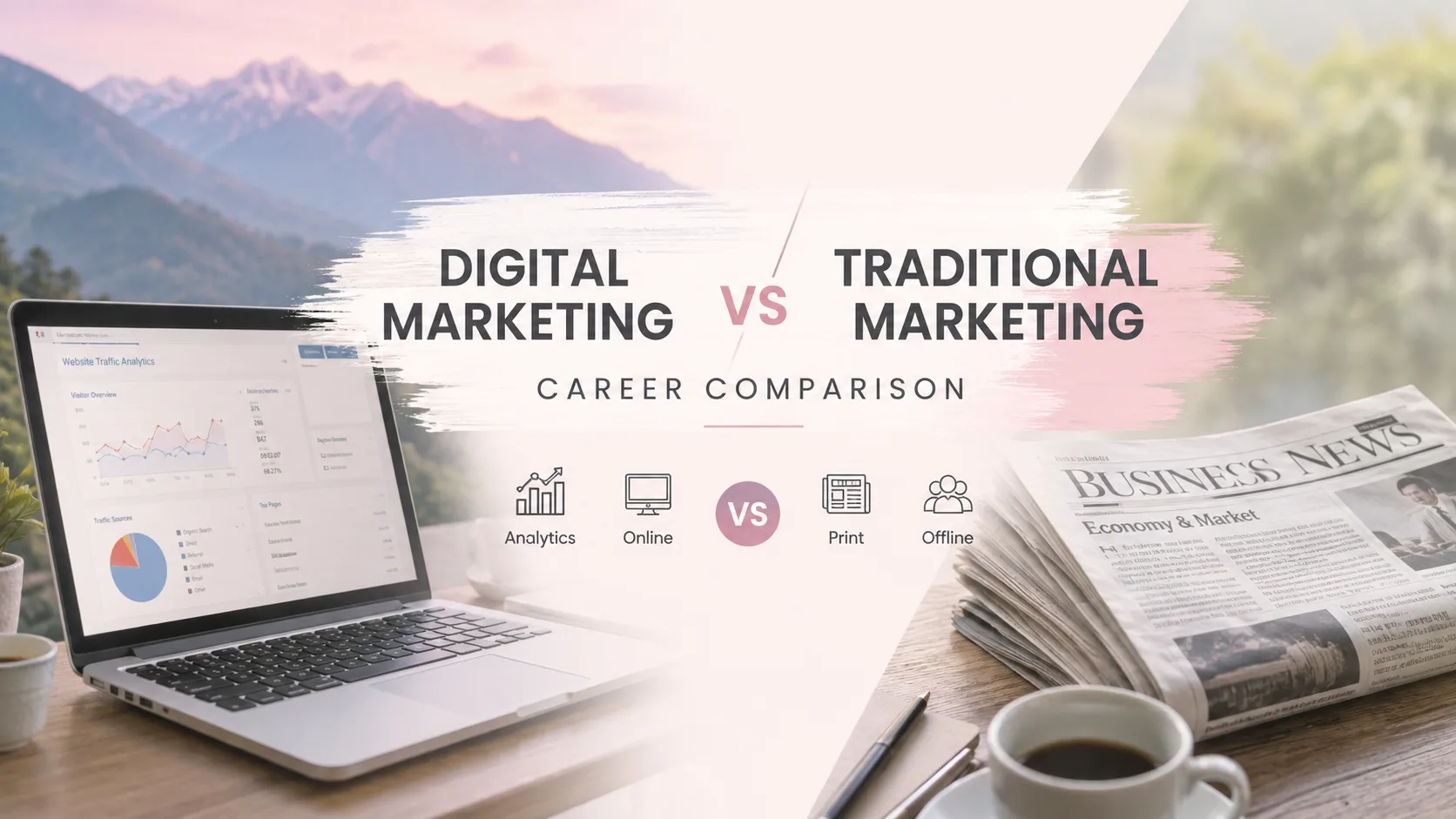
Digital Marketing vs Traditional Marketing: Career Comparison
| Career Factor | Digital Marketing | Traditional Marketing |
| Core channels | Search, social, email, websites | TV, print, radio, outdoor |
| Measurement | Highly data-driven | Often harder to measure directly |
| Key skills | Analytics, SEO, paid media, content | Branding, media planning, PR, events |
| Work style | Fast-moving and experimentation-driven | Campaign and media-planning focused |
| Career specialization | High | Moderate to high |
| Remote opportunities | Available in many roles | More dependent on the role |
| Automation | High | Generally lower |
| Learning curve | Frequent platform and algorithm changes | More stable channel knowledge |
Neither path is universally better. The better choice depends on your interests and the kind of professional life you want to build.
Digital Marketing Career Opportunities
Digital marketing has developed into a broad career ecosystem. An SEO Specialist works with keyword research, technical SEO, content optimization, and search performance. A Performance Marketing Specialist manages paid campaigns and evaluates metrics such as customer acquisition cost and return on advertising spend.
A Social Media Manager develops content calendars, manages communities, and analyzes social campaigns. A Content Marketing Specialist creates blogs, videos, guides, and broader content strategies.
Students who enjoy technology and customer journeys may find email and marketing automation particularly interesting, involving segmentation, lead nurturing, and automated campaigns. Those who prefer numbers can pursue digital marketing analytics, working with dashboards, attribution, and campaign analysis.
With experience, professionals can move into roles such as Digital Marketing Manager, where strategy, budgeting, team management, and channel planning become central responsibilities.
Traditional Marketing Career Opportunities
Traditional marketing offers its own diverse career paths. Brand Managers work on positioning and brand strategy, while Media Planners determine where and when advertising should appear. Advertising Account Executives coordinate campaigns and client relationships.
Those who enjoy communication may prefer Public Relations, while highly organized individuals may thrive in Event Marketing. Market Research Analysts study consumers and markets, and Marketing Communications Managers coordinate messaging across campaigns.
These roles can be especially appealing to people who enjoy relationship-building, presentations, branding, negotiations, and collaborative campaign planning.
What Skills Do You Need?
A digital marketing career benefits from a combination of technical, creative, and interpersonal abilities. Useful technical skills include SEO, Google Ads, Meta Ads, analytics, CRM platforms, marketing automation, content management systems, conversion optimization, and data analysis.
But technology alone is not enough. Copywriting, storytelling, visual communication, critical thinking, problem-solving, adaptability, and project management are equally valuable.
Traditional marketers need skills such as brand strategy, media planning, market research, advertising, public relations, negotiation, event management, consumer behavior, and presentation.
The overlap is important: communication, creativity, consumer understanding, strategic thinking, and adaptability matter in both careers.
Salary and Career Growth
There is no single salary figure that accurately represents either field. Compensation depends on experience, role, location, industry, company size, specialization, performance, and whether someone works in-house, at an agency, or independently.
At entry level, internships and junior roles provide opportunities to develop practical skills. At mid-level, specialization can lead to stronger responsibility and management opportunities. At senior level, professionals may move into positions such as Marketing Manager, Growth Manager, Head of Marketing, Marketing Director, or Digital Strategy Lead.
Digital marketing also offers additional routes through freelancing, consulting, agency work, remote roles, and specialized services.
Which Career Has Better Growth Potential?
Digital marketing currently offers numerous specialized digital-first career paths because businesses increasingly depend on online discovery, e-commerce, performance marketing, automation, and data.
Traditional marketing remains valuable for brand management, advertising, media, public relations, FMCG, consumer brands, events, and offline campaigns.
The most resilient approach may therefore be to understand the foundations of marketing while developing strong digital capabilities.
How AI Is Changing Marketing Careers
AI is rapidly changing how marketers research, create, analyze, and optimize campaigns. AI-assisted content creation, automated reporting, customer segmentation, predictive analytics, campaign optimization, personalization, and marketing automation are becoming increasingly important.
Rather than simply eliminating marketing jobs, AI is likely to change what marketers spend their time doing. The professionals who stand out will combine marketing knowledge + data skills + AI literacy + creativity + strategic thinking.
Can You Combine Digital and Traditional Marketing?
Absolutely. Modern marketing is increasingly integrated.
Imagine a campaign beginning with a television advertisement, followed by social media content, search advertising, a landing page, email communication, and retargeting. Each channel contributes to the same customer journey.
This is why professionals who understand both digital and traditional marketing can bring valuable perspective to integrated campaigns.
Which Career Is Right for You?
Consider digital marketing if you enjoy analytics, technology, experimentation, social media, online platforms, and measurable results.
Consider traditional marketing if you enjoy branding, advertising, media, events, public relations, communications, and relationship management.
Consider learning both if you want broader strategic marketing expertise and hope to work on integrated campaigns for growing brands.
How to Start a Digital Marketing Career
A practical path can begin with six steps:
- Learn marketing fundamentals.
- Choose a specialization such as SEO, paid media, social media, content, analytics, or email marketing.
- Learn relevant industry tools.
- Build a portfolio using SEO projects, content campaigns, analytics dashboards, social campaigns, or simulated advertising projects.
- Gain practical experience through an internship, freelancing, personal projects, or agency work.
- Keep learning, particularly as platforms, algorithms, and AI tools evolve.
This is where practical education can make a significant difference. At PulsePlay Academy, learning digital marketing can be connected to the wider professional ecosystem of PulsePlay Digital, giving students an opportunity to move beyond classroom concepts and understand how digital work functions in practice.
After completing their course, an internship experience can help students work with real-world processes, develop professional discipline, strengthen portfolios, and gain a clearer understanding of potential career paths. Like learning to navigate the mountain trails around Dharamshala, the journey becomes easier when theory is followed by experience.
Conclusion
The choice between digital and traditional marketing does not have to be a choice between the past and the future. Traditional marketing continues to shape brands through media, communication, events, and memorable offline experiences, while digital marketing has opened new possibilities through data, technology, automation, social platforms, and measurable campaigns.
For aspiring marketers, the strongest long-term foundation may be a combination of marketing fundamentals, digital expertise, AI literacy, analytics, creativity, and practical experience.
And perhaps that is the most valuable lesson students can take from the learning environment at PulsePlay Academy in Dharamshala: career growth, much like a Himalayan journey, is not about rushing toward the highest point. It is about building the right skills, gaining experience step by step, staying adaptable, and knowing which direction to take next.
Frequently Asked Questions
Neither is universally better. Digital marketing offers many technology-driven specializations, while traditional marketing remains strong in branding, media, advertising, PR, and events.
It can be a strong career option for people willing to continuously develop their digital, analytical, creative, and AI-related skills.
Yes. Brands continue to invest in advertising, media, events, public relations, communications, and offline campaigns.
Earnings vary considerably by experience, specialization, location, employer, performance, and career level. It is better to evaluate the complete career path rather than rely on a single salary comparison.
Yes. Practical projects, certifications, portfolios, internships, and demonstrable skills can help candidates build an entry path.
AI is changing marketing work, but marketers still need strategic judgment, creativity, customer understanding, communication, and decision-making.