
PHP & MySQL: Is It Still Worth Learning in 2027?
Backend development continues to play an important role in building modern websites, web applications and online platforms. From managing customer accounts to processing online orders, websites depend on backend technologies to handle data and application functionality. PHP and MySQL are two technologies that have supported this development for many years.
But with newer technologies such as Node.js, Python and modern JavaScript frameworks becoming popular, many beginners ask: Is PHP and MySQL still worth learning in 2027?
The answer is yes. PHP and MySQL remain practical technologies for backend development, particularly for WordPress websites, content management systems, e-commerce platforms and database-driven applications. They also provide a useful foundation for understanding how websites work behind the scenes.
However, learning PHP and MySQL alone may not be enough to build a complete development career. Beginners should also explore JavaScript, modern PHP frameworks, database security and practical application development to develop relevant industry skills.
What Are PHP and MySQL?
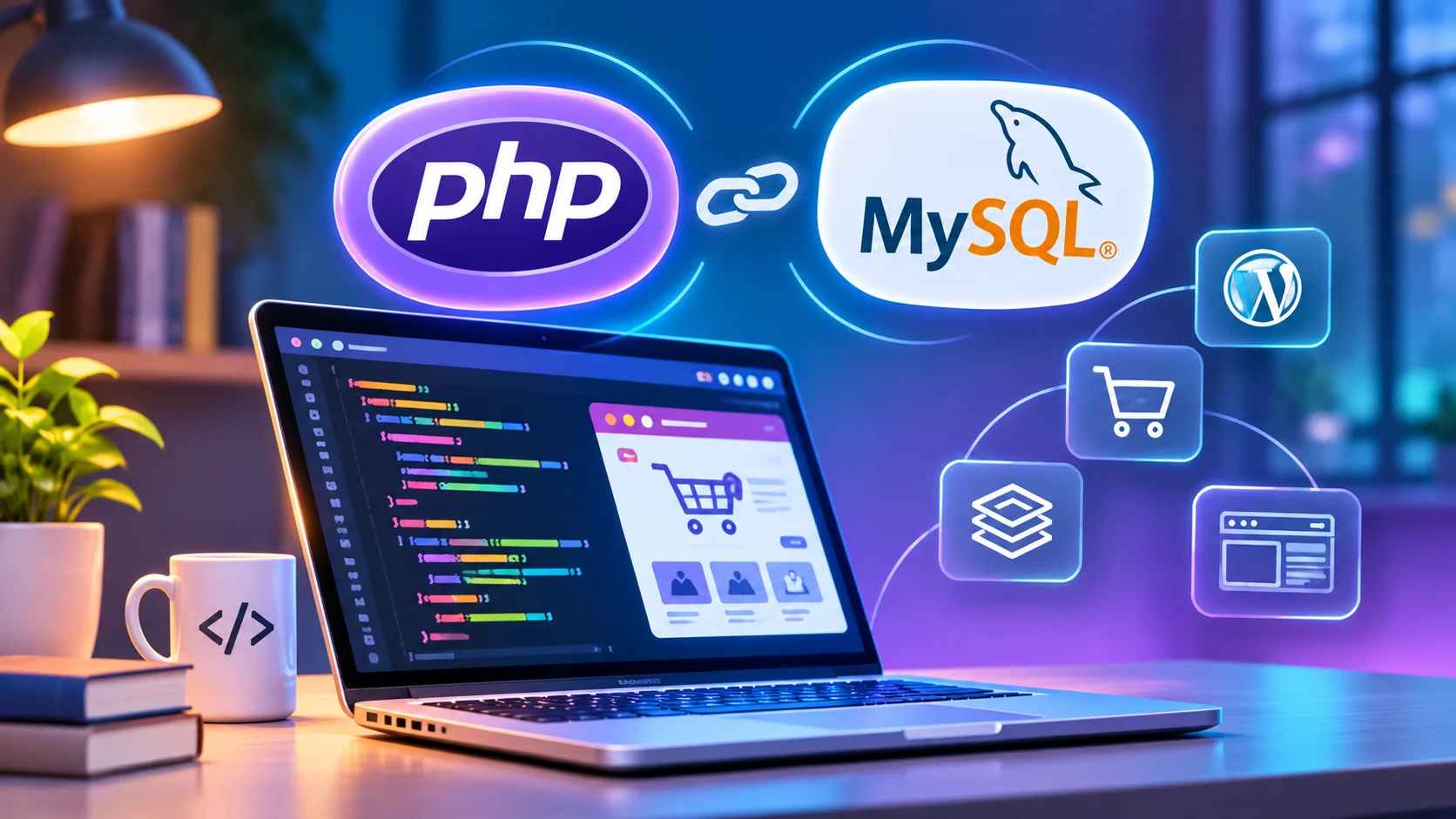
PHP and MySQL are two different technologies that work together to create dynamic, database-driven websites. PHP handles server-side programming, while MySQL manages the information stored by an application.
Understanding their individual roles is the first step towards learning backend development.
What Is PHP?
PHP (Hypertext Preprocessor) is a server-side scripting language primarily used for web development. It allows developers to create dynamic websites and applications by processing information on a web server.
Unlike static HTML pages, PHP can generate different content depending on user interactions, database information and application requirements.
Common uses of PHP include:
- Processing website contact and registration forms.
- Managing user authentication and login sessions.
- Creating dynamic website pages.
- Handling shopping cart functionality.
- Connecting websites with databases.
- Developing WordPress themes and plugins.
- Building backend functionality for web applications.
For example, when a user logs into a website, PHP can verify their submitted credentials against information stored in a database and determine whether access should be granted.
What Is MySQL?
MySQL is a relational database management system (RDBMS) used to store, organise and retrieve structured information.
Websites and applications generate different types of data, such as customer details, product information, transactions and user activities. MySQL helps developers manage this information through databases, tables and SQL queries.
Common applications of MySQL include:
- Storing customer registration details.
- Managing product catalogues.
- Maintaining order and payment records.
- Storing blog posts and website content.
- Managing student information.
- Organising employee and inventory records.
For example, an e-commerce website can use MySQL to store product names, prices, stock availability and customer orders.
How Do PHP and MySQL Work Together?
PHP and MySQL work together to process user requests and deliver dynamic website content.
PHP handles the application logic, while MySQL stores and retrieves the required information. When a visitor interacts with a website, PHP can communicate with MySQL to retrieve or update data.
Here is a simple example of how they work together:
- A user opens a website and submits a registration form.
- PHP receives and validates the submitted information.
- PHP sends an appropriate query to the MySQL database.
- MySQL stores the user’s information.
- PHP processes the database response.
- The website displays a registration confirmation.
Simple PHP and MySQL workflow:
User Request → PHP Processing → MySQL Database → PHP Response → Website Output
This combination makes it possible to build websites that can store information, respond to users and manage different application functions.
Is PHP Still Relevant in 2027?
Yes, PHP remains relevant in 2027 because many websites, content management systems and web applications depend on it for backend functionality.
Although several newer programming technologies are available, PHP continues to support established web development ecosystems. Its use in WordPress, e-commerce platforms and custom web applications makes it a practical skill for developers.
Some important reasons PHP remains relevant include:
- WordPress development: PHP powers WordPress core functionality, themes and plugins.
- E-commerce websites: Developers use PHP to create and maintain online shopping functionality.
- Backend applications: PHP supports authentication, database operations and server-side application logic.
- Modern frameworks: Frameworks such as Laravel help developers build structured and maintainable applications.
- Existing website maintenance: Businesses need developers to maintain, secure and upgrade existing PHP applications.
PHP also continues to receive updates and security improvements. Its official documentation provides information about supported versions, release schedules and maintenance policies. As of November 2026, PHP 8.6 has entered its release cycle, alongside supported branches including PHP 8.5, 8.4 and 8.3. Developers should check the official support table before selecting a version for production projects.
Official reference: https://www.php.net/supported-versions.php
PHP in WordPress Development
WordPress is one of the most recognised content management systems, and PHP plays a central role in its functionality.
Developers use PHP to customise WordPress themes, develop plugins and create additional website features.
For example, businesses may need custom contact forms, membership systems, booking functionality or dynamic website sections. PHP allows developers to implement these features according to specific requirements.
Learning PHP can therefore help beginners explore WordPress development, theme customisation and website maintenance opportunities.
PHP in E-commerce Development
E-commerce websites require backend functionality to manage products, customers, shopping carts and orders.
PHP can handle several of these operations by processing customer requests and communicating with databases.
Some common applications include:
- Product catalogue management.
- Customer registration and login.
- Shopping cart functionality.
- Order processing.
- Inventory management.
- Payment gateway integrations.
PHP developers can help businesses build and maintain these features while ensuring that customer and transaction information is handled securely.
PHP in Web Application Development
PHP is also used to develop database-driven web applications.
Businesses use web applications to manage daily operations, generate reports and provide online services to customers and employees.
Examples include customer dashboards, employee management systems, appointment booking platforms and reporting applications.
PHP handles the backend logic, while MySQL stores the information required by these applications.
PHP in Website Maintenance and Modernisation
Not every business develops a website from scratch. Many organisations already operate websites and applications built using PHP.
These applications require regular maintenance, security improvements, performance optimisation and compatibility updates.
PHP developers can help organisations:
- Upgrade older PHP applications.
- Fix backend errors and bugs.
- Improve database performance.
- Update website functionality.
- Implement security improvements.
- Integrate APIs and third-party services.
This makes PHP knowledge useful for both new development projects and existing application maintenance.
Why Should Beginners Learn PHP and MySQL in 2027?
Learning PHP and MySQL can help beginners understand how websites operate beyond their visual appearance.
Frontend development focuses on what visitors see and interact with, while backend development handles application logic, databases and server-side operations.
Here are some important reasons beginners should consider learning these technologies.
1. Understand Backend Programming Fundamentals
PHP introduces beginners to essential programming concepts such as variables, conditions, loops, functions and object-oriented programming.
These concepts are useful when learning other programming languages and frameworks.
2. Learn Database Management
MySQL helps learners understand how applications store, organise and retrieve information.
Students can practise creating databases, managing tables and writing SQL queries.
3. Build Dynamic Websites
Combining PHP and MySQL allows beginners to create websites that respond to user interactions rather than displaying only static content.
4. Explore CMS and E-commerce Development
PHP knowledge is useful for working with WordPress, custom CMS platforms and PHP-based e-commerce applications.
5. Develop Practical Problem-Solving Skills
Building real-world projects teaches learners how to solve programming problems, handle errors and manage application data.
6. Create a Foundation for Full-Stack Development
After learning PHP and MySQL, beginners can expand their knowledge with JavaScript, HTML, CSS, APIs and frameworks such as Laravel.
What Can You Build Using PHP and MySQL in 2027?
One of the biggest advantages of learning PHP and MySQL is the ability to develop practical applications.
Beginners can start with simple projects and gradually move towards more complex systems.
Dynamic Business Websites
Businesses need websites that allow visitors to interact with their services and access relevant information.
Using PHP and MySQL, developers can create:
- Contact and enquiry forms.
- Customer registration systems.
- Admin dashboards.
- Dynamic service pages.
- Customer information management systems.
These features help businesses manage website information and customer interactions.
Content Management Systems
A content management system allows users to create, edit, organise and publish website content without manually modifying every page.
PHP and MySQL can be used to develop custom CMS platforms with features such as:
- Content creation and editing.
- User role management.
- Image and media uploads.
- Category management.
- Publishing workflows.
- Admin dashboards.
E-commerce Websites
PHP and MySQL can support different components of an online shopping platform.
Developers can build product listing pages, customer accounts, shopping carts, order management systems and inventory databases.
They can also integrate payment gateways and other third-party services using appropriate APIs.
Student Management Systems
Educational institutions can use database-driven applications to manage student information.
A PHP and MySQL-based student management system can include:
- Student registration.
- Student profiles.
- Course information.
- Attendance records.
- Examination details.
- Fee management.
This is also a useful beginner project for understanding database relationships and CRUD operations.
Job Portals and Booking Platforms
PHP and MySQL can be used to develop platforms that connect users with services and opportunities.
For example, a job portal may include employer accounts, candidate profiles, job listings and application tracking.
Similarly, a booking platform can manage appointment schedules, customer details and booking records.
Custom Web Applications
Businesses often require applications designed around their specific operational needs.
PHP and MySQL can support custom solutions such as:
- Inventory management systems.
- Employee management applications.
- Reporting dashboards.
- Customer relationship management systems.
- Internal business portals.
Building these projects helps beginners understand how programming concepts are applied to practical business problems.
PHP vs Other Backend Technologies in 2027
PHP is not the only option available for backend development. Technologies such as Node.js, Python and Java also support modern web applications.
Each technology has its own ecosystem, advantages and common applications.
| Technology | Common Use Cases | Learning Consideration |
|---|---|---|
| PHP | WordPress, CMS, e-commerce and backend websites | Useful for PHP-based web development |
| Node.js | APIs, real-time applications and JavaScript backends | Suitable for full-stack JavaScript development |
| Python | Backend development, automation, AI and data science | Offers applications beyond web development |
| Java | Enterprise applications and large-scale backend systems | Useful for enterprise software development |
Which technology should beginners choose?
The answer depends on their learning objectives.
- Choose PHP if you are interested in WordPress, CMS platforms and PHP-based backend development.
- Choose Node.js if you want to work with JavaScript across frontend and backend development.
- Choose Python if you are interested in backend programming, automation, AI or data-related applications.
- Choose Java if you want to explore enterprise software and large-scale application development.
There is no single programming language that is best for every development project.
Beginners can also explore our guide to Programming Languages to Learn for Beginners to understand different programming options and their applications.
PHP Developer Career Opportunities in 2027
Learning PHP and MySQL can open different career paths for individuals interested in web development.
However, career opportunities depend on practical programming knowledge, project experience, problem-solving abilities and familiarity with modern development tools.
Some career options include:
PHP Developer
PHP developers create and maintain server-side functionality for websites and web applications.
Their responsibilities may include writing PHP code, connecting databases, developing website features and fixing application errors.
Backend Developer
Backend developers manage the server-side components of applications.
They work with databases, APIs, authentication systems and application logic to ensure that websites and applications function correctly.
PHP and MySQL can provide a foundation for this career path.
WordPress Developer
WordPress developers use PHP to customise themes, develop plugins and implement additional website functionality.
They may also work on website performance, security, integrations and ongoing maintenance.
E-commerce Website Developer
E-commerce developers build and maintain online shopping platforms.
Their work can include product management, customer accounts, checkout functionality, payment integrations and database operations.
Freelance Web Developer
Freelancers can use PHP and MySQL to develop websites and provide technical services to businesses and individual clients.
Possible freelance projects include:
- Business website development.
- WordPress customisation.
- Website maintenance.
- Database integration.
- Custom web application development.
- E-commerce functionality.
People interested in understanding different development roles can also explore our guide on Frontend vs Backend Development.
What Skills Should You Learn Alongside PHP and MySQL in 2027?
PHP and MySQL provide a strong starting point for backend development, but modern developers need additional technical skills to build complete applications.
Here are some important technologies and concepts beginners should learn alongside them.
HTML and CSS
HTML defines the structure of a website, while CSS controls its visual presentation.
Developers need these technologies to create web pages, forms, layouts and user interfaces that connect with backend functionality.
JavaScript
JavaScript adds interactivity and dynamic behaviour to websites.
It is used for form validation, interactive menus, dynamic content and asynchronous requests.
Developers can also use JavaScript with Node.js for server-side development.
Object-Oriented PHP
Object-oriented programming (OOP) helps developers organise code into reusable components.
Important concepts include:
- Classes and objects.
- Inheritance.
- Encapsulation.
- Polymorphism.
- Abstraction.
Understanding OOP makes it easier to develop structured and maintainable PHP applications.
SQL and Database Management
Learning SQL is essential for working with MySQL databases.
Beginners should understand:
- Creating and managing databases.
- Writing SELECT, INSERT, UPDATE and DELETE queries.
- Working with primary and foreign keys.
- Understanding database relationships.
- Using JOIN operations.
- Learning indexing and database optimisation.
These skills help developers manage application information efficiently.
PHP Frameworks
Frameworks provide reusable tools and structures that make application development more organised.
Laravel is one of the popular PHP frameworks used for building modern web applications.
It offers features such as routing, database management, authentication support and application structure.
Learning Laravel after understanding PHP fundamentals can help developers work on more advanced projects.
APIs and Git
APIs allow different applications and services to communicate with each other.
Developers should understand REST APIs, HTTP methods, JSON data and API integration.
Git is a version control system that helps developers track code changes and collaborate with other team members. GitHub provides a platform for hosting and managing code repositories.
Security and Deployment
Security is an important part of backend development.
Beginners should learn:
- Input validation and sanitisation.
- Prepared statements to prevent SQL injection.
- Secure password hashing.
- Authentication and session management.
- Access control.
- Secure application configuration.
- Website hosting and deployment.
These concepts help developers build applications that are more secure and reliable.
PHP vs JavaScript: Which Should Beginners Learn First in 2027?
PHP and JavaScript serve different purposes in web development, although both can be used for backend programming.
PHP is primarily associated with server-side development, whereas JavaScript is widely used for frontend development and can also support backend applications through Node.js.
| Factor | PHP | JavaScript |
|---|---|---|
| Main Role | Server-side development | Frontend and server-side development |
| Backend Use | Yes | Yes, using Node.js |
| Frontend Use | Usually alongside HTML and JavaScript | Yes |
| Common Ecosystem | Laravel, WordPress | React, Angular, Node.js |
| Suitable For | Backend and CMS-focused learners | Frontend and full-stack JavaScript learners |
Which one should beginners learn first?
Choose PHP if you want to focus on backend development, WordPress customisation and database-driven applications.
Choose JavaScript if you want to start with frontend development and later explore backend programming through Node.js.
Both technologies are useful, and beginners can eventually learn both to expand their development capabilities.
How Long Does It Take to Learn PHP and MySQL?
The time required to learn PHP and MySQL depends on your previous programming experience, daily study hours and practical learning approach.
Beginners who practise consistently can understand the fundamentals and build simple applications through a structured learning plan.
Here is an indicative three-month learning roadmap.
| Learning Stage | Topics to Cover | Practical Activities |
|---|---|---|
| Month 1 – PHP Fundamentals | Variables, conditions, loops, functions and arrays | Build basic PHP programs |
| Month 2 – MySQL Basics | Databases, tables, SQL queries and relationships | Create and manage databases |
| Month 3 – PHP and MySQL Integration | Database connections, forms, sessions and CRUD operations | Build a login and registration system |
| After the Basics – Advanced Skills | OOP, Laravel, APIs, Git and deployment | Develop complete web applications |
The timeline is indicative rather than a fixed learning duration.
Students who practise regularly and build projects alongside theoretical learning can develop a better understanding of programming concepts.
How to Start Learning PHP and MySQL as a Beginner in 2027
Starting with the right learning sequence makes programming easier to understand.
Instead of learning everything simultaneously, beginners should focus on one concept at a time and apply it through practical exercises.
Learn Basic HTML and CSS
Start by understanding how websites are structured and designed.
Learn HTML elements, forms, headings, links, images and CSS properties such as colours, spacing and layouts.
These skills will help you understand how frontend pages connect with backend functionality.
Understand PHP Fundamentals
Once you understand basic website structure, start learning PHP.
Focus on variables, data types, operators, conditional statements, loops, functions and arrays.
Practise writing small programs to understand how PHP processes information.
Learn MySQL and SQL Queries
Next, understand how databases work.
Learn how to create databases, tables and relationships. Practise SQL queries to insert, retrieve, update and delete information.
You should also understand primary keys, foreign keys and basic database design.
Connect PHP with MySQL
After learning the fundamentals of both technologies, practise connecting PHP with a MySQL database.
Start with simple projects such as contact forms and registration systems.
Learn how to use prepared statements, validate user input and manage database operations securely.
Build Practical Projects
Practical projects help transform theoretical knowledge into development skills.
Start with simple applications and gradually increase their complexity.
Some useful beginner projects include:
- Login and registration systems.
- Student management systems.
- Contact form applications.
- Blog management systems.
- Simple e-commerce websites.
Building these projects will help you understand how PHP and MySQL work together in real-world applications.
To follow a structured learning path, beginners can explore the PHP and MySQL Course for Beginners offered by PulsePlay Academy.
The course is listed at beginner level and includes 98 lessons covering PHP fundamentals, MySQL queries, database integration, login and registration forms, password hashing and prepared statements.
Is PHP and MySQL a Good Career Choice for Beginners in 2027?
PHP and MySQL can be a good starting point for beginners who want to develop practical web development skills.
They are particularly useful for people interested in backend programming, WordPress development, CMS platforms and database-driven applications.
Here are some learner groups who may benefit from learning these technologies.
Students Starting Their Programming Journey
Students can use PHP and MySQL to understand programming fundamentals, server-side logic and database management.
Beginners Interested in Backend Development
People who want to understand how websites process information and communicate with databases can start with these technologies.
WordPress and CMS Developers
PHP knowledge is useful for customising WordPress themes, developing plugins and managing CMS-based websites.
Freelancers Interested in Website Development
Freelancers can use PHP and MySQL to build dynamic websites, provide maintenance services and develop custom business applications.
Developers Interested in Application Maintenance
People who want to work on existing websites and applications can benefit from understanding PHP code, database operations and security updates.
However, PHP and MySQL may not be the best starting combination for everyone. Someone primarily interested in AI and machine learning may prefer Python, while someone focused on enterprise software may want to explore Java.
The right choice depends on your long-term career interests and the type of applications you want to develop.
Final Verdict: Is PHP and MySQL Still Worth Learning in 2027?
Yes, PHP and MySQL are still worth learning in 2027, particularly for beginners interested in backend development, WordPress, e-commerce and database-driven web applications.
Their continued use in established web development ecosystems makes them practical skills for building and maintaining websites.
However, becoming a capable web developer requires more than understanding PHP syntax and writing SQL queries. Learners should also develop knowledge of JavaScript, object-oriented programming, Laravel, APIs, database security and application deployment.
The best approach is to understand the fundamentals, practise through real-world projects and gradually explore modern development tools.
If you are starting your programming journey, PulsePlay Academy’s PHP and MySQL course can help you build a foundation in backend development through structured lessons and practical concepts.
Frequently Asked Questions
Yes, PHP is still worth learning in 2027. It is used in WordPress development, e-commerce websites, content management systems and database-driven applications. Learning PHP can help beginners understand backend programming and explore web development opportunities.
Yes, MySQL remains relevant for web development. It is a relational database management system used to store and retrieve information such as customer details, product records, transactions and website content.
Yes, learning PHP and MySQL can help you prepare for entry-level opportunities such as PHP developer, junior backend developer and WordPress developer. However, employers also look for practical project experience, problem-solving skills and knowledge of additional technologies.
PHP can be approachable for beginners because its basic syntax and programming concepts are relatively straightforward to understand. Learning variables, conditions, loops and functions provides a good starting point before moving towards database integration and frameworks.
PHP is a server-side programming language used to develop website functionality, while MySQL is a relational database management system used to store and manage information. PHP can communicate with MySQL to retrieve, insert, update and delete application data.
Yes, you can build dynamic websites using PHP and MySQL. They can support user registration, login systems, contact forms, content management, product catalogues and other database-driven website features.
Choose PHP if you are interested in WordPress, CMS platforms and PHP-based backend development. Choose Python if you want to explore backend development, automation, artificial intelligence or data science. Your career interests should guide your decision
Neither technology is universally better. PHP is useful for WordPress, CMS and PHP-based web applications, while Node.js is popular for JavaScript-based backends, APIs and real-time applications. The right choice depends on project requirements and development goals.
After learning PHP and MySQL, explore object-oriented PHP, Laravel, JavaScript, REST APIs, Git, database optimisation and web application security. These skills can help you develop more advanced backend and full-stack applications.
Beginners may understand the fundamentals of PHP and MySQL within approximately three months with consistent practice. Building advanced applications and becoming comfortable with frameworks such as Laravel requires additional learning and project experience.
Yes, PHP is an essential part of WordPress development. It powers WordPress core functionality and is used to develop themes, plugins and custom website features.
Yes, PHP and MySQL can provide a foundation for full-stack development. You should also learn HTML, CSS, JavaScript, frontend frameworks, APIs and deployment practices to develop complete web applications.