

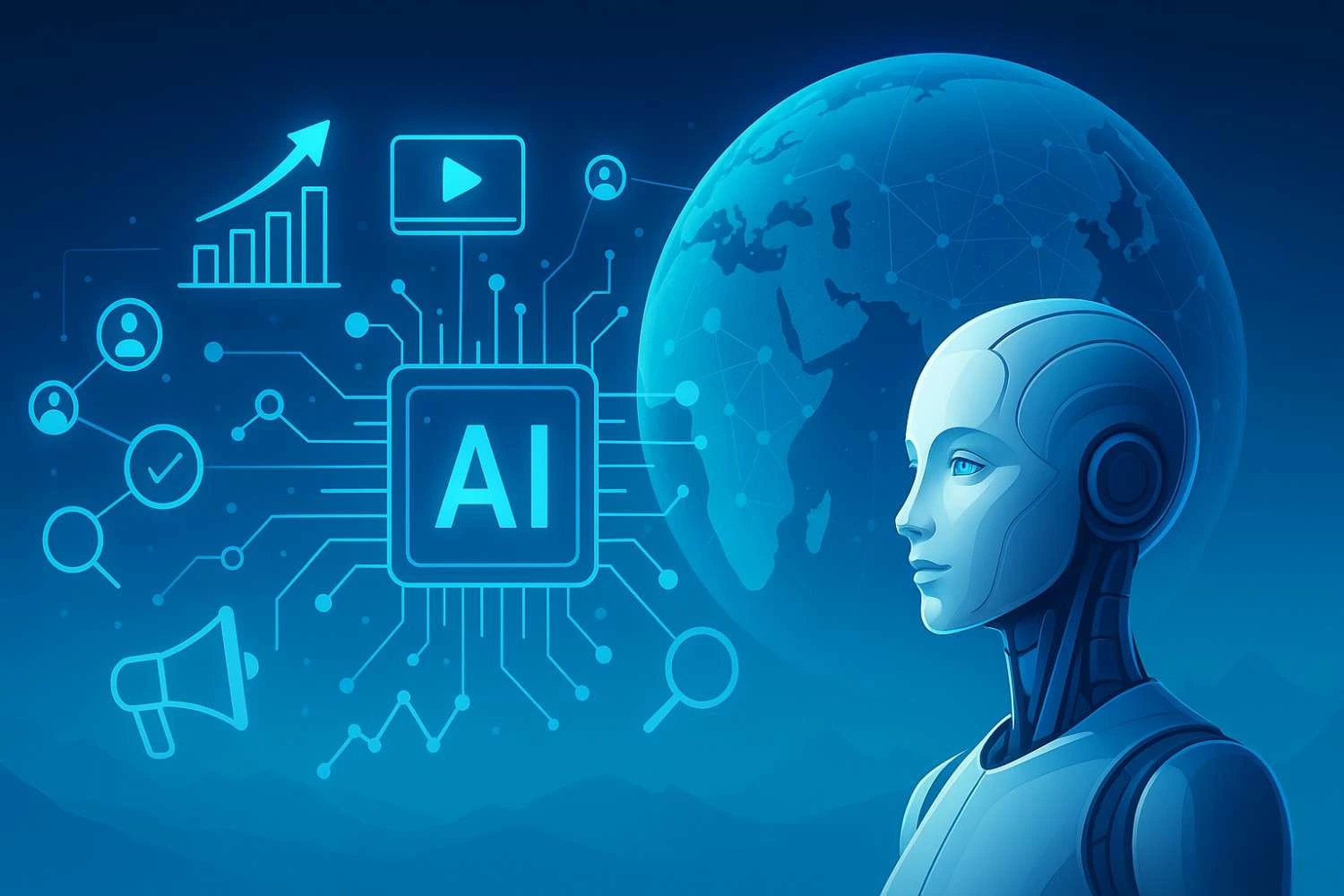
How AI Is Transforming the Digital Marketing Industry
Artificial intelligence has quietly moved from being a “nice-to-have” to the invisible engine running modern campaigns. Today, AI in digital marketing helps brands automate repetitive tasks, uncover deep customer insights, and deliver personalized experiences across every channel.
From smarter ad targeting and predictive analytics to AI-powered chatbots that respond instantly, AI is transforming digital marketing into a faster, more precise, and more profitable growth machine.
What This Guide Covers
In this guide on how AI is transforming marketing, we’ll walk you through:
● Core ways AI is changing digital marketing
● Popular AI-powered marketing tools for automation, targeting, and content
● Key benefits of AI for marketers, businesses, and brands
● Real-world applications of AI across major digital channels
● The future of digital marketing with AI (2026–2030) and what to prepare for
Here at PulsePlay Academy in Dharamshala, surrounded by the calm of the Himalayas but plugged into the global digital world, we see daily how AI is reshaping the skills students need. This guide is designed to help you understand that shift—and get ready for it.
Why AI Matters in Digital Marketing
Before diving into specific use cases, it’s important to understand why AI in digital marketing has become so important.
1. Faster data processing
Marketing generates huge amounts of data—clicks, searches, purchases, watch time, scroll depth, and more. Humans can’t manually scan millions of data points and spot patterns quickly. AI tools can:
● Process large datasets in seconds
● Identify which campaigns, keywords, or creatives are driving results
● Automatically adjust strategies based on performance trends
This speed is critical in a world where customer behavior can change overnight.
2. Real-time customer insights
AI doesn’t just crunch data; it continuously learns from it. That means:
● Real-time updates on what your audience is engaging with
● Instant alerts when performance drops
● Suggestions on what to change—timing, messaging, audience, or budget
Instead of relying on last month’s report, marketers get live feedback and can act immediately.
3. Reduced manual workload
Many marketing tasks are repetitive:
● Scheduling social media posts
● Sending emails to different audience segments
● Optimizing bids in ad platforms
● Sorting leads based on quality
With AI marketing automation, these tasks can be handled by algorithms, freeing marketers to focus on strategy, creativity, and experimentation.
Higher ad ROI
Every click and impression costs money. AI improves return on ad spend by:
● Finding the right audience for each campaign
● Automatically testing multiple versions of ads (A/B or multivariate)
● Allocating more budget to winning campaigns and cutting poor performers
This is one of the most direct ways AI in digital marketing impacts a brand’s bottom line.
4. Better audience understanding
AI helps marketers move beyond basic demographics like age and location. It can group users based on:
● Behavior (what they click, watch, or buy)
● Intent (search terms, on-site actions)
● Engagement level (loyal customers vs. first-time visitors)
This deeper understanding allows for more relevant and human-feeling experiences, even though they are powered by machines.
Key Areas Where AI Is Transforming Digital Marketing
Let’s explore the main areas where AI-powered marketing tools are changing how campaigns are planned, created, optimized, and delivered.
1. AI in Personalization
Personalization is one of the clearest examples of how AI is transforming marketing.
Dynamic product recommendations
When you see “Recommended for you” sections on e-commerce sites, those are usually driven by AI models that analyze:
● Your browsing history
● Your previous purchases
● What similar users have liked
AI can then recommend products or content that feel tailored to each individual user, increasing clicks, time on site, and conversions.
Personalized email and website content
AI tools can:
● Show different homepage banners based on user behavior
● Adjust messaging for returning customers vs. new visitors
● Recommend unique email content for each segment
Instead of one generic campaign for all, AI enables thousands of micro-personalized experiences that happen automatically.
2. AI in Content Creation & Optimization
Content remains central to the future of digital marketing with AI, but the way it’s created and optimized is evolving.
AI for blogs, videos, and social media
AI tools can assist with:
● Generating blog outlines, headlines, and first drafts
● Suggesting video scripts or hooks based on trending topics
● Rewriting content for different platforms (Instagram, LinkedIn, YouTube descriptions)
● Translating and localizing content for different regions
These tools speed up the content workflow, especially for small teams and solo marketers.
SEO optimization and keyword research
AI supports SEO by:
● Discovering relevant keywords based on search intent
● Analyzing competitor content to spot gaps
● Suggesting internal linking and topic clusters
● Optimizing meta titles, descriptions, and headings
Instead of guessing, SEO strategies become more data-driven and aligned with how people actually search.
3. AI in Predictive Analytics
Predictive analytics is where AI really shines, turning past data into future insights.
Customer behavior prediction
AI can model:
● Which leads are most likely to convert
● Which customers might churn soon
● What offer is most likely to drive a purchase
This helps marketers prioritize their efforts, design better nurturing journeys, and refine targeting.
Future demand forecasting
Brands can use AI to predict:
● Seasonal spikes in demand
● Future inventory requirements
● Likely revenue from different campaigns or channels
This leads to smarter budgeting, better stock planning, and more efficient campaigns.
4. AI in Paid Advertising (PPC)
Paid ads are one of the most visible areas where AI marketing automation is already dominant.
Smart bidding
Platforms like Google Ads and Meta Ads use AI to:
● Automatically adjust bids for each auction
● Optimize for a chosen goal (clicks, conversions, ROAS)
● Learn from user behavior to improve results over time
Marketers set the strategy; AI handles real-time bidding decisions.
Automated budget optimization
AI monitors how campaigns are performing and:
● Shifts budget from low-performing ads to high-performers
● Stops underperforming keywords or audiences
● Tests new combinations of targeting and creative
This ensures budgets are constantly working as efficiently as possible.
Precise audience targeting
Instead of manually creating hundreds of audience segments, AI can:
● Analyze user behavior signals
● Build lookalike audiences
● Find people with similar interests and intent
This level of precision is a key part of how AI is transforming marketing, especially in competitive niches.
5. AI in Social Media Marketing
Social media moves quickly, and AI helps marketers keep up.
Automated posting
AI-powered tools can:
● Suggest the best posting times
● Schedule content across multiple platforms
● Reuse content in different formats
This ensures consistency without needing to log in manually every time.
Sentiment analysis
AI can scan comments, mentions, and reviews to understand:
● Whether overall sentiment is positive, negative, or neutral
● What customers love or dislike about your brand
● Emerging issues before they turn into crises
This feedback loop helps brands adjust messaging and offerings quickly.
Trend prediction
By analyzing hashtags, engagement spikes, and content patterns, AI can:
● Spot early trends in your industry
● Suggest topics likely to perform well
● Help you ride trends before they peak
For learners at PulsePlay Academy, understanding how to interpret these AI insights is becoming as important as writing a good post.
6. AI in Chatbots & Customer Support
Chatbots are one of the most familiar examples of AI in digital marketing.
24/7 support
AI chatbots can:
● Answer FAQs instantly
● Help customers track orders
● Guide users through product pages
This improves customer experience and reduces wait times—even when human agents are offline.
AI conversational assistants
More advanced conversational AI can:
● Ask qualifying questions
● Offer relevant products or solutions
● Escalate complex issues to human agents
This blends automation with human support and ensures customers feel heard.
Lead qualification
AI chatbots can also:
● Collect contact details
● Score leads based on their answers and behavior
This shortens the sales cycle and keeps pipelines full without extra manual work.
● Send qualified leads directly to sales teams
7. AI in Email Marketing
Email continues to be one of the highest-ROI channels, and AI is making it even more powerful.
Automated segmentation
AI can segment your list based on:
● Opens, clicks, and purchases
● On-site behavior
● Engagement levels (cold, warm, hot)
Instead of static lists, you get dynamic segments that update in real time.
Personalized subject lines
AI tools can:
● Suggest subject lines likely to increase open rates
● Test different versions and learn what works
● Tailor lines to different segments or individuals
This small change can lead to big improvements in performance.
Predictive send-time optimization
AI analyzes when each subscriber is most likely to open and:
● Sends emails at the optimal time for each person
● Improves open and click-through rates
● Reduces unsubscribes from poorly timed campaigns
This is another example of AI marketing automation quietly working in the background.
8. AI in Image & Video Marketing
Visual content is central to modern marketing, and AI is transforming how it’s created and managed.
AI-generated visuals
AI tools can:
● Generate product mockups
● Design ad creatives based on brand guidelines
● Create variations of images for testing
This helps teams produce high-quality visual content faster.
AI-powered video editing
AI assists with:
● Automatic captioning and subtitling
● Cutting long videos into shorter social clips
● Detecting the most engaging moments in a video
This is especially useful for brands repurposing webinars, interviews, or podcasts.
Branding consistency
AI can check visuals and content against brand guidelines to ensure:
● Consistent colors, fonts, and tone
● Correct logo usage
● Alignment with visual identity
This keeps large teams or agencies aligned without heavy manual review.
Benefits of AI in Digital Marketing
Let’s bring it all together. The key benefits of AI in digital marketing include:
1. Higher conversions
With better personalization, smarter targeting, and improved recommendations, AI helps:
● Show the right message to the right person at the right time
● Reduce friction in the customer journey
● Increase the likelihood of sign-ups, purchases, and repeat visits
2. Faster workflow
By handling repetitive tasks, AI-powered marketing tools:
● Speed up content production
● Simplify reporting and analytics
● Allow teams to launch and optimize campaigns more quickly
This is crucial for agencies and businesses that need to move fast.
3. Improved customer experience
AI-powered personalization, chatbots, and recommendations make experiences:
● More relevant
● More responsive
● More seamless across channels
Happy customers mean better reviews, stronger loyalty, and higher lifetime value.
4. More accurate targeting
With AI analyzing behavior, intent, and engagement:
● Targeting becomes more precise than manual segmentation
● Wasted impressions are reduced
● Campaigns reach people who are more likely to care
Lower marketing cost
Over time, AI helps:
● Cut ineffective campaigns
● Focus budgets on proven strategies
● Reduce time and money spent on manual tasks
This combination of lower cost and better results is a big reason why the future of digital marketing with AI looks so strong.
Challenges & Limitations
AI is powerful, but it’s not magic. There are challenges to keep in mind.
1. Data privacy concerns
AI relies on data. Marketers must:
● Respect privacy laws and regulations
● Be transparent about data collection and usage
● Use data ethically and securely
Trust is a long-term asset; misusing data can destroy it quickly.
2. Over-reliance on AI
If marketers blindly follow AI suggestions:
● All brands can end up sounding the same
● Unique positioning and creativity can get lost
● Important nuances may be missed
AI should support decisions, not replace human judgment.
3. Need for human creativity
AI is great with patterns, but:
● Humans still lead on brand storytelling
● Emotional connection requires genuine human insight
● Big, bold creative ideas rarely come from algorithms
The most successful marketers will blend AI’s power with human creativity and empathy.
4. Tool cost and integration
Implementing AI can involve:
● Subscription costs for tools
● Time to train teams
● Integration with existing systems (CRM, CMS, ad platforms)
This can be challenging for small businesses, but the long-term benefits usually make it worthwhile.
Future of AI in Digital Marketing (2026–2030)
Looking ahead, the future of digital marketing with AI is likely to bring even more dramatic changes.
1. Hyper-personalization
We’ll move from basic segmentation to:
● Experiences tailored at the individual level
● Websites that completely adapt based on user behavior
● Offers designed in real time for each visitor
This will make campaigns feel less like “marketing” and more like relevant, helpful interactions.
2. Voice-search dominance
As voice assistants become more powerful:
● Voice SEO will become critical
● AI will help brands optimize for natural language queries
● Conversational interfaces will become a key touchpoint
Marketers will need to think beyond screens.
3. AI-driven creative content
AI will increasingly help with:
● Generating creative concepts
● Designing visual campaigns
● Composing music or voiceovers for ads
Human creatives will act as directors—guiding, curating, and refining AI outputs.
4. Autonomous campaign management
We’re moving toward systems that can:
● Plan campaigns based on objectives
● Allocate budgets across channels
● Test creatives and audiences automatically
● Learn and optimize with minimal human input
Marketers will shift from “doers” to strategists, overseeing AI-driven campaigns and focusing on brand, messaging, and ethics.
Here at PulsePlay Academy and PulsePlay Digital, we’re already preparing learners and interns for this reality—teaching them not just tools, but the strategic thinking needed to work alongside AI.
AI and Your Career: Learning with PulsePlay Academy
If you’re inspired by how AI is transforming digital marketing and want to build a future-proof career, you need both conceptual understanding and hands-on practice.
At PulsePlay Academy in Dharamshala, our Digital Marketing courses:
● Cover AI tools for SEO, PPC, social media, and automation
● Teach you how to interpret AI-generated insights and apply them
● Help you design campaigns that combine creativity with data
Through our collaboration with PulsePlay Digital, students also get access to internship opportunities where they can:
● Work on live AI-assisted campaigns
● Use real AI-powered marketing tools in agency workflows
● Build a portfolio that shows employers you’re ready for the AI-driven marketing world
It’s a blend of Himalayan calm and global digital hustle—learning surrounded by mountains, while working with the same tools used by leading brands.
Conclusion: AI as Your Marketing Co-pilot
To sum up, how AI is transforming the digital marketing industry can be seen in every part of the funnel:
● Smarter targeting and personalized experiences
● Faster, more accurate decision-making
● Automated workflows that save time and money
● Predictive analytics that guide strategy
AI doesn’t replace marketers—it empowers them. The real advantage goes to those who can combine AI’s analytical power with human creativity, empathy, and strategic thinking.
If you’re ready to be that kind of marketer, start learning about AI in digital marketing today. The earlier you adapt, the more valuable you’ll be in an industry where AI isn’t the future anymore—it’s the present.
FAQs
AI is transforming digital marketing by automating repetitive tasks, improving targeting, and providing real-time insights. It powers smarter ad bidding, personalized content, predictive analytics, and 24/7 customer support through chatbots. In short, AI helps marketers make better decisions faster and deliver more relevant experiences.
Some common categories of AI-powered marketing tools include:
● SEO and keyword research tools
● AI copy generators and content assistants
● Ad optimization and bidding tools
● Email marketing automation platforms
● Chatbots and conversational assistants
● Social media scheduling and sentiment analysis tools
The “best” tool depends on your goals, budget, and tech stack.
AI analyzes large amounts of data—demographics, behavior, purchase history, and engagement—to segment audiences more precisely than manual methods. It can automatically identify high-intent users, build lookalike audiences, and adjust targeting in real time to reach people most likely to convert.
AI is very useful for:
● Generating ideas and outlines
● Drafting short-form and long-form content
● Rewriting and repurposing existing content
However, human review is essential. Marketers should refine AI-generated content to ensure accuracy, brand voice, and originality. Think of AI as a powerful writing assistant, not a replacement for human creativity.
In PPC, AI marketing automation supports:
● Smart bidding in ad auctions
● Automated budget allocation
● Testing multiple ad variations
● Identifying winning keywords and audiences
This leads to higher ROI, less wasted spend, and better-performing campaigns with less manual effort.
AI enables personalization at scale by:
● Recommending products or content based on user behavior
● Adjusting website or app experiences for different users
● Personalizing emails, ads, and offers in real time
It moves brands from generic messaging to experiences that feel tailored to each individual.
AI can replace certain repetitive or data-heavy tasks, but not digital marketers as a whole. Humans are still crucial for:
● Strategy and brand positioning
● Creative direction and storytelling
● Ethical decision-making and empathy
The most successful marketers will be those who know how to use AI as a co-pilot rather than seeing it as competition.
In email marketing, AI helps with:
● Segmenting audiences based on behavior and engagement
● Personalizing subject lines and content
● Optimizing send times for each subscriber
● Predicting which users are likely to unsubscribe or convert
This leads to higher open rates, better engagement, and more revenue from email campaigns.
Predictive analytics uses AI and machine learning to forecast future outcomes based on historical data. In marketing, it’s used to:
● Predict which leads will convert
● Estimate future sales
● Identify customers at risk of churn
● Plan budgets and inventory more accurately
It turns “guessing” into data-driven planning.
AI improves conversion rates by:
● Delivering more relevant content and offers
● Reducing friction in the customer journey
● Providing instant support via chatbots
● Optimizing landing pages and ad creatives based on performance data
By continuously learning from user behavior, AI helps marketers refine campaigns and experiences until more visitors become customers.